Today is the Opening Day of the Olympic Games
in Beijing.
Some thoughts by Confucius:
"Life is really simple, but we insist on making it complicated."
"A journey of a thousand miles begins with one step."
"He who will not economize will have to agonize."
"Success has many fathers, failure is an orphan."
"It does not matter how slowly you go so long as you do not stop."
.User-generated
content and weblogs - a new challenge
By EU - Information Society
As weblogs represent an important new contribution to media
pluralism, there is a need to clarify their status, and to create
legal safeguards for use in the event of lawsuits as well as
to establish a right to reply, says a recent own initiative
report drafted by Estonian Socialist Marianne Mikko. Own initiative
reports are drafted by individual MEPs and are not proposals
for EU laws. The report was later adopted by Parliament's Culture
Committee
This article
has been corrected to reflect amendments by Parliament's Culture
Committee, which affected some of the positions in the draft
report that we had previously reported.
The report - adopted by MEPs on the Culture Committee on 3
June - also says there is "considerable risk" that
the private media's pursuit of profit could compromise its
ability to act as a watchdog for democracy. It goes on to
suggest "implies a need to establish legal safeguards
providing for the assignment of liability in the event of
lawsuits, and establishing the right to reply".
"The cases of unrestricted ownership concentration or
of scarce content pluralism in the media are endangering cultural
diversity and freedom of expression not only within national
markets but also at European level. We need therefore strong
European commitment to overcome those challenges especially
in view of the new technologies and services in the media
sector", said Committee chair Greek Socialist Katarina
Batzeli (PES).
Weblogs and other new on-line media pose new challenges, say
MEPs. The growth of commercial media outlets for user-generated
content, such as photos and videos, used without paying a
fee, raises problems of ethics and privacy, and puts journalists
and other media professionals under pressure, they say.
The report "on concentration and pluralism in the media
in the European Union" - drafted by Estonian Socialist
Marianne Mikko - also warns against the concentration of the
media in the hands of a few companies because the media is
vital to safeguarding democracy. "The media remains a
powerful tool, which should not be treated solely in economic
terms," she said. The report calls for social and legal
guarantees to journalists and editors. It will be put to the
vote in the full plenary in the future.
Ms Mikko told us "the blogosphere has so far been a haven
of good intentions and relatively honest dealing. However,
with blogs becoming commonplace, less principled people will
want to use them".
Asked if she considered bloggers to be "a threat",
she said "we do not see bloggers as a threat. They are
in position, however, to considerably pollute cyberspace.
We already have too much spam, misinformation and malicious
intent in cyberspace". She added, "I think the public
is still very trusting towards blogs, it is still seen as
sincere. And it should remain sincere. For that we need a
quality mark, a disclosure of who is really writing and why.
"
Belgian MEP Ivo Belet (who acted as an advisor on the report
for the Industry committee) said "weblogs and user generated
content contribute in a lively and fresh way to a colourful
and many-sided media landscape. They should not be restrained".
The centre right EPP-ED member did concede however that some
legal issues such as privacy and the right of reply need to
be addressed.
German Liberal Jorgo Chatzimarkakis acted as advisor for the
Economic and Monetary committee. He told us that "bloggers
cannot automatically be considered a threat, but imagine pressure
groups, professional interests or any other groups using blogs
to pass on their message. Blogs are powerful tools, they can
represent an advance form of lobbyism, which in turn can be
seen as a threat". He said "any blogger representing
or expressing more than their personal view should be affected
by this report."
EU Commission
earmarks single radio frequency for road safety and traffic management
As part of its overall fight against road accidents and traffic
jams, the Commission decided today to reserve, across Europe, part
of the radio spectrum for smart vehicle communications systems (so
called co-operative systems). They are based on wireless communication
technology and allow cars to 'talk' to other cars and to the road
infrastructure providers. They can, for example, warn other drivers
of slippery roads or of a crash which just happened. Smart vehicle
communication systems have the potential to make safer and ease
the lives of Europe's drivers: in 2006, more than 42,000 people
died in road accidents in the European Union and more than 1.6 million
were injured while every day there are some 7,500 km of traffic
jams on the EU's roads. The Commission Decision also intends to
foster investment in smart vehicle communication systems by the
automotive industry, at the same time spurring public funding in
essential roadside infrastructure.
The
Top Six Trends report was developed by ACMA - Australian Communications
and Media Authority - to provide a concise overview of technology,
applications and services trends over the next five to 10 years.
1. An accelerating pace of change driven by overlapping
developments in technology, and connections between people, databases
and objects.
2. Diversity in the development of physical infrastructure
including broadband, digital broadcasting, smart radio systems,
sensor networks, mesh networks, efficiency techniques in multimedia
transmission, location sensing and context-aware technologies, intelligent
transport systems and satellite services.
3. Continuing spread of connectivity through the integration
of information processing beyond the desktop into everyday objects
and activities.
4. Enhanced content and network management capabilities driven
by developments in deep packet inspection and content filtering
technologies, coupled with the need to improve e-security, identity
management, intellectual property protection and energy efficiency.
5. The emerging social web acting both as platform
and database, enabling innovation and creativity by users and service
providers.
6. Continuing scientific and technological innovation,
which
in combination are driving advances in computing power, display
technologies, artificial intelligence and nanotechnology.
[...]
advert
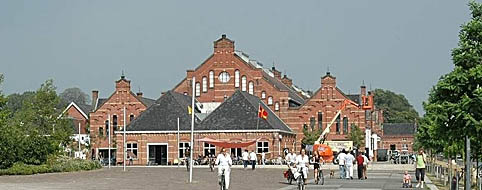
Westergasfabriek
Amsterdam
If you're looking for an adventurous place
in Amsterdam, then the Westergasfabriek Culture Park is worth a
visit. Art and culture form the basis of this down-to-earth industrial
complex close to the centre of Amsterdam. The new energy is tangible
for everyone who visits for work, play, exercise, entertainment
or events.
Just about anything
goes in these historic buildings; from a photo shoot to major
audience events, from weddings to exclusive product presentations.
The venues available for a temporary hire are: the magnificent
circular Gasometer (2500 m2), the Transformer House with its sacred
mood (700 m2), the impressive Purification Hall (1200 m2), the
intimate Machine Building with chapel (340 m2) and the small Eastern
Meter House (60 m2), furnished as a meeting room. The outdoor
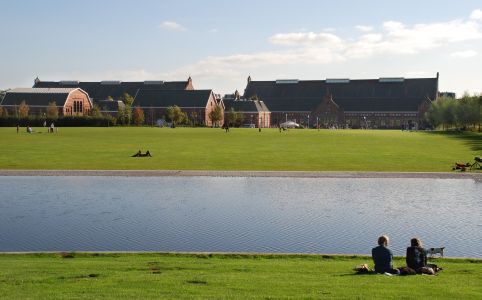
spaces such as the quayside, the larger meadow or the gardens
of the park can also be used for events.
The Westergasfabriek
is freely accessible all day. From early in the morning, there's
fresh bread and fine coffee at the Baker's Shop (open every day)
and the Espresso Factory (open tue - sun). There are various galleries
and shops, Pacific Parc cafe/restaurant/dancing (open everyday)
and the food-design studio Proef (open: fri-sun). The Ketelhuis
Cinema (open everyday) shows the latest films and in the Flex
Bar (open thu - sun) you can dance late in the night. Opening
soon: The WestergasTerras for drinks, dinner, parties & salsa
near the wetlands. The modern park surrounding the site offers
plenty of space, peace and nature; for a picknick, to throw a
frisby or a pleasant walk. You are most welcome.
Studio
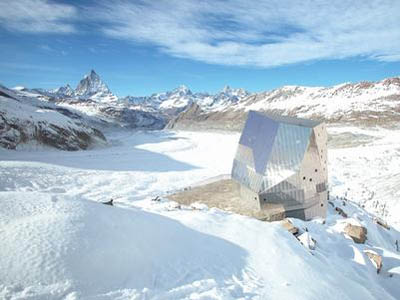
Monte Rosa is
a special mountain hut, which has been planned for the Swiss Alpine
Club (SAC) by the Department of Architecture. The project covers
from the conception to the final execution all the phases and
technological blocks needed for the realization of this unique
building. In fact, the new Studio Monte Rosa is in the middle
of a natural reserve with extreme alpine conditions, yet energeticaly
to 90% self-contained and self-sufficient (90% autarchy).
In splendid isolation, on the edge of a glacier in pristine wilderness,
the hut will be able to host 125 guests in the restaurant and
hotel with very little environmental impact. The four floors will
be realised in a wooden pre-fabricated structure. The realisation
of bio-gas generation for human waste recycling is also being
considered.
This book brings together some of the most outstanding and novel papers
on media and development presented at the 2004 AMIC Annual Conferences.
It provides a wealth of fresh case studies as well as breaking new
ground in highlighting emerging frontiers of media development discourse
in Asia, comparing regional development along multiple dimensions
and frameworks, and pointing the direction towards further media initiatives
at a national level. The papers selected are grouped into three key
themes: media and development; new narratives and political discourse;
and media impacts and capacity building. The contributors to this
book have highlighted not just an interesting range of media and development
issues in Asia, but have also introduced a good variety of media research
methods. These include quantitative assessments of media impacts in
society, comparative and longitudinal frameworks for evaluating regional
ICT competitiveness, structural analyses of political and activist
communication systems, in-depth case studies of individual organisations,
and broad-based surveys of stakeholders in ICT4D.
.'Major
discovery' from MIT
'Major discovery' from MIT primed to unleash solar revolution
Scientists mimic essence of plants' energy storage system
By Anne Trafton, News Office
In a revolutionary
leap that could transform solar power from a marginal, boutique
alternative into a mainstream energy source, MIT researchers
have overcome a major barrier to large-scale solar power:
storing energy for use when the sun doesn't shine.
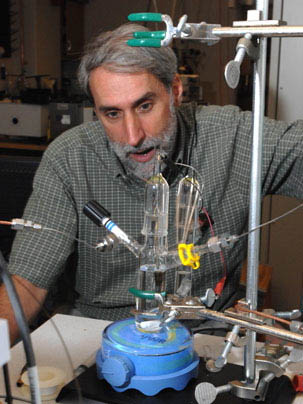
Photo / Donna Coveney
Daniel G. Nocera, the Henry Dreyfus Professor of Energy at
MIT, has developed a simple method to split water molecules
and produce oxygen gas, a discovery that paves the way for
large-scale use of solar power.
Until now, solar
power has been a daytime-only energy source, because storing
extra solar energy for later use is prohibitively expensive
and grossly inefficient. With today's announcement, MIT researchers
have hit upon a simple, inexpensive, highly efficient process
for storing solar energy.
Requiring nothing
but abundant, non-toxic natural materials, this discovery
could unlock the most potent, carbon-free energy source of
all: the sun. "This is the nirvana of what we've been
talking about for years," said MIT's Daniel Nocera, the
Henry Dreyfus Professor of Energy at MIT and senior author
of a paper describing the work in the July 31 issue of Science.
"Solar power has always been a limited, far-off solution.
Now we can seriously think about solar power as unlimited
and soon."
Inspired by the
photosynthesis performed by plants, Nocera and Matthew Kanan,
a postdoctoral fellow in Nocera's lab, have developed an unprecedented
process that will allow the sun's energy to be used to split
water into hydrogen and oxygen gases. Later, the oxygen and
hydrogen may be recombined inside a fuel cell, creating carbon-free
electricity to power your house or your electric car, day
or night.
The key component
in Nocera and Kanan's new process is a new catalyst that produces
oxygen gas from water; another catalyst produces valuable
hydrogen gas. The new catalyst consists of cobalt metal, phosphate
and an electrode, placed in water. When electricity -- whether
from a photovoltaic cell, a wind turbine or any other source
-- runs through the electrode, the cobalt and phosphate form
a thin film on the electrode, and oxygen gas is produced.
Combined with
another catalyst, such as platinum, that can produce hydrogen
gas from water, the system can duplicate the water splitting
reaction that occurs during photosynthesis.
The new catalyst
works at room temperature, in neutral pH water, and it's easy
to set up, Nocera said. "That's why I know this is going
to work. It's so easy to implement," he said.
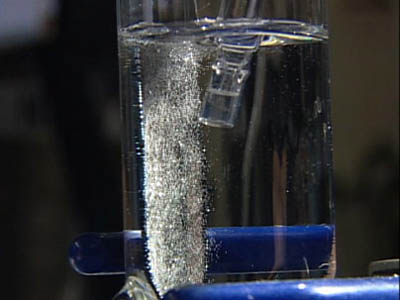
Photo / Tom White, MIT
MIT researchers have developed a new catalyst, consisting
of cobalt metal, phosphate and an electrode. When the catalyst
is placed in water and electricity runs through the electrode,
oxygen gas is produced. When another catalyst is used to produce
hydrogen gas, the oxygen and hydrogen can be combined inside
a fuel cell, creating carbon-free electricity to power a house
or an electric car, day or night.
'Giant leap'
for clean energy
Sunlight has the greatest potential of any power source to
solve the world's energy problems, said Nocera. In one hour,
enough sunlight strikes the Earth to provide the entire planet's
energy needs for one year.
James Barber,
a leader in the study of photosynthesis who was not involved
in this research, called the discovery by Nocera and Kanan
a "giant leap" toward generating clean, carbon-free
energy on a massive scale.
"This is
a major discovery with enormous implications for the future
prosperity of humankind," said Barber, the Ernst Chain
Professor of Biochemistry at Imperial College London. "The
importance of their discovery cannot be overstated since it
opens up the door for developing new technologies for energy
production thus reducing our dependence for fossil fuels and
addressing the global climate change problem."
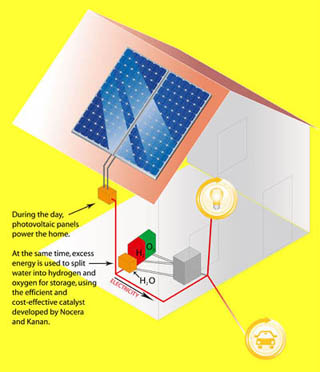
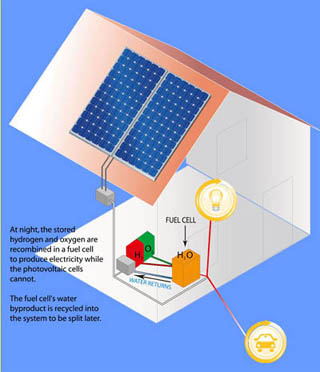
Graphic / Patrick Gillooly, MIT
With Daniel Nocera's and Matthew Kanan's new catalyst, homeowners
could use their solar panels during the day to power their
home, while also using the energy to split water into hydrogen
and oxygen for storage. At night, the stored hydrogen and
oxygen could be recombined using a fuel cell to generate
power while the solar panels are inactive.
'Just the
beginning'
Currently available electrolyzers, which split water with
electricity and are often used industrially, are not suited
for artificial photosynthesis because they are very expensive
and require a highly basic (non-benign) environment that has
little to do with the conditions under which photosynthesis
operates.
More engineering work needs to be done to integrate the new
scientific discovery into existing photovoltaic systems, but
Nocera said he is confident that such systems will become
a reality.
"This is just the beginning," said Nocera, principal
investigator for the Solar Revolution Project funded by the
Chesonis Family Foundation and co-director of the Eni-MIT
Solar Frontiers Center. "The scientific community is
really going to run with this."
Nocera hopes
that within 10 years, homeowners will be able to power their
homes in daylight through photovoltaic cells, while using
excess solar energy to produce hydrogen and oxygen to power
their own household fuel cell. Electricity-by-wire from a
central source could be a thing of the past.
The project is
part of the MIT Energy Initiative, a program designed to help
transform the global energy system to meet the needs of the
future and to help build a bridge to that future by improving
today's energy systems. MITEI Director Ernest Moniz, Cecil
and Ida Green Professor of Physics and Engineering Systems,
noted that "this discovery in the Nocera lab demonstrates
that moving up the transformation of our energy supply system
to one based on renewables will depend heavily on frontier
basic science."
The success of the Nocera lab shows the impact of a mixture
of funding sources - governments, philanthropy, and industry.
This project was funded by the National Science Foundation
and by the Chesonis Family Foundation, which gave MIT $10
million this spring to launch the Solar Revolution Project,
with a goal to make the large scale deployment of solar energy
within 10 years.
advert
Sichuan Food
Reguliersdwarsstraat 35, 1017BK Amsterdam
tel. +31 (0)20 626 9327, fax +31 (0)20 627 7281
Open daily from 17.30 to 23.00 http://sichuan-food.orientalrestaurants.nl
"First Michelin
star Chinese restaurant in Europe. Top Chinese kitchen and quality
service. The Peking duck is amazing. The restaurant owner is a
member of the Order of Oranje." - Six Star Society
"Considered
one of the area's top Chinese restaurants, this small venue entertains
a host of adherents. Although it boasts a somewhat formal atmosphere,
it isn't in the least bit off-putting. The cuisine is of good
quality too, judiciously spiced and rife with fresh ingredients.
Peking duck is excellent, and an array of chicken, beef, pork,
and seafood dishes also please local palates. Set menus take care
of those who desire the full dining experience, and the value
is generally quite satisfying." - 10Best Restaurant Reviews
"Not far from
Rembrandtplein, this restaurant (honored several times over by
restaurant guides) prepares authentic Chinese food, most notably
Szechuan specialties as its name indicates. Inside, the Chinese
decor is sombre, drawing attention to a mysteriously blue-lit
aquarium of exotic fish." - Thalys
.Futurist
Portrait: Jane McGonigal
Jane McGonigal
is a game designer,
a games researcher, a future forecaster, and a very playful human
being.
"I make games that give a damn. I study how games change
lives. I spend a lot of my time figuring out how the games we
play today shape our real-world future. And so I'm trying to make
sure that a game developer wins a Nobel Prize by the year 2032."
As an "alternate reality" designer, she specializes
in projects that connect game worlds with the real world.
Her games are usually
physically active, massively multi-player and highly collaborative.
Her primary goal
as a designer is to create large-scale collaborative communities,
to improve players' real quality of life, and to solve real-world
problems, by overlaying game systems and game content on top
of everyday reality.
Her best known
projects include The Lost Ring (with AKQA, 2008) and The Lost
Sport (2008), World Without Oil (with Ken Eklund and ITVS, 2007),
a collaborative simulation of a global oil shortage; Cruel 2
B Kind (with Ian Bogost, 2006), a real-world assassination game
that replaced weapons with random acts of kindness; Tombstone
Hold 'Em (with 42 Entertainment and Activision, 2005), which
infused historic cemeteries with live adventure; and I Love
Bees (with 42 Entertainment and Microsoft, 2004), the groundbreaking
alternate reality game that turned 1000 payphones worldwide
into a platform for collective intelligence.
Previously, she
was a lead designer at 42 Entertainment, the company that invented
the genre of alternate reality games.
RESEARCH
As a games researcher,
she focuses on how games can save the real world.
Most recently,
her research has focused on how to teach collaboration strategies
and collective intelligence skills through alternate reality
games, and was supported by the MacArthur Foundation's initiative
on digital media and youth.
She has a PhD in
performance studies from UC Berkeley. Her dissertation, "This
Might Be a Game", which she completed in 2006, focuses
on the ways that alternate reality games influence and change
the real world. Her dissertation received the international
Leonardo Art + Technology Award for the most significant new
media research filed in Fall 2006.
While at UC Berkeley,
she was a member of UC Berkeley's Alpha Lab in the Department
of Industrial Engineering and Operations Research and a resident
game designer for the Berkeley Institute of Design. Her most
widely cited research games include PlaceStormers (2005), Tele-Twister
(2003), and Organum (2004).
THE FUTURE
As a future forecaster,
she explores how games are changing the way we conduct and influence
real business, real health care, real scientific research, and
our real social lives.
She focuses on
ways that alternate reality games in particular could lead to
a higher quality of life in both Western and developing nations,
and how they could produce more engaging and thriving democracies
worldwide.
She has been a
researcher with the Institute for the Future since January 2007,
where she also develops massively multiplayer forecasting games.
Club
of Amsterdam Open Business Club
Are you interested in networking, sharing visions,
ideas about your future, the future of your industry, society, discussing
issues, which are relevant for yourself as well as for the 'global'
community? The future starts now - join ouronline
platform ...: http://www.openbc.com/go/invuid/Felix_Bopp2
.Contact
Your
comments, ideas, articles are welcome!
Please write to Felix Bopp, Editor-in-Chief: editor@clubofamsterdam.com


 Club
of Amsterdam Journal.
Club
of Amsterdam Journal.